

Ever wondered what’s brewing beyond our atmosphere? Space weather might sound like a sci-fi movie plot, but it’s the real deal, affecting everything from satellite communications to your favorite GPS app. Imagine a cosmic storm that can turn your navigation system into a lost puppy—no one wants that!
As the sun unleashes its solar flares and winds, Earth’s magnetic field dances in response, creating a spectacle that’s both beautiful and potentially disruptive. Understanding space weather isn’t just for astronauts or scientists; it’s crucial for everyone. So grab your space helmet and prepare to dive into the wild world of solar storms, magnetic mayhem, and the cosmic forces that could impact your daily life. Who knew the universe had such a sense of humor?
Overview of Space Weather
Space weather encompasses various phenomena resulting from interactions between solar activity and Earth’s atmosphere. Solar flares release bursts of radiation, impacting communication systems and power grids. Solar winds, streams of charged particles emitted by the sun, create disturbances in Earth’s magnetic field.
Geomagnetic storms arise when these solar winds collide with Earth’s magnetosphere. These storms can enhance the auroras, creating stunning visuals in polar regions. Disruptions to satellite services can occur, affecting navigation systems and telecommunications.
Studies indicate that major solar events influence power systems, leading to voltage fluctuations and transformer damage. The National Oceanic and Atmospheric Administration (NOAA) monitors space weather conditions to provide alerts on potential threats. With ongoing advances in technology, understanding these phenomena becomes crucial for mitigating impacts on infrastructure.
Monitoring instruments like satellites and ground-based observatories collect data on solar activity. This data allows scientists to predict space weather events effectively. Organizations track solar cycles and evaluate the likelihood of intense solar storms. Awareness of space weather not only benefits scientists but serves the wider population reliant on technology daily.
Overall, awareness of space weather’s implications leads to better preparedness for disruptions it may cause. Increased interest in space weather reflects its significance in the modern technological landscape.
The Sun’s Influence on Space Weather
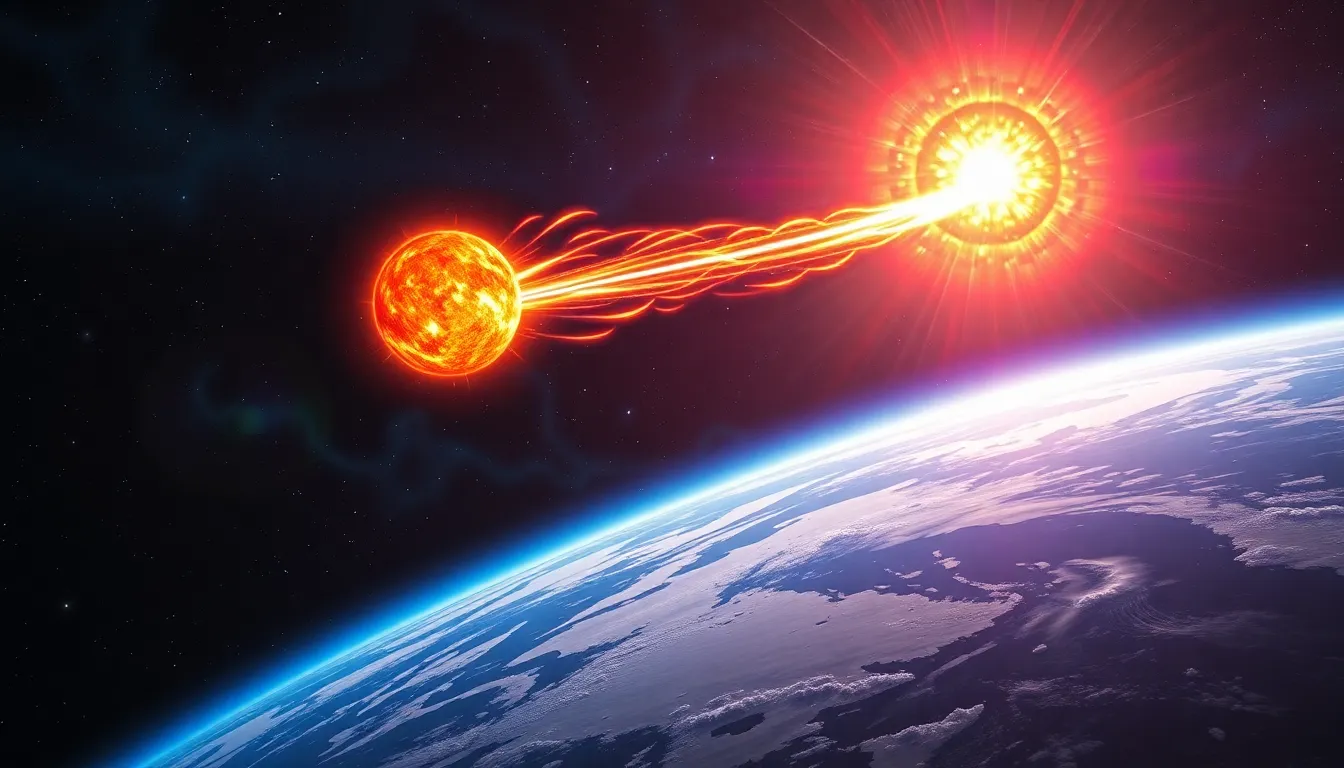
The sun plays a critical role in shaping space weather, primarily through solar flares and solar winds. These phenomena can disrupt technological systems and produce mesmerizing visuals.
Solar Flares and Coronal Mass Ejections
Solar flares occur when the sun releases enormous bursts of energy. They emit high-energy radiation, impacting radio communications and satellite operations. Coronal mass ejections (CMEs) often accompany solar flares, releasing large quantities of plasma and magnetic fields into space. When directed toward Earth, CMEs can induce geomagnetic storms, causing voltage fluctuations and damaging power infrastructure. Observing solar activity enables scientists to forecast these events, allowing for timely alerts.
Solar Wind and Its Effects
Solar wind consists of charged particles that stream continuously from the sun. This wind interacts with Earth’s magnetic field, producing phenomena like auroras. Although stunning, solar wind can disrupt satellite functionality, GPS accuracy, and radio transmissions. Geomagnetic storms triggered by solar wind lead to increased drag on satellites in low Earth orbit, affecting their trajectories. Monitoring solar wind’s speed and density helps predict these disturbances, providing essential data to protect critical technologies.
Impact of Space Weather on Earth
Space weather significantly impacts Earth, influencing technology and communications. Solar activity, particularly geomagnetic storms, poses risks to various systems.
Geomagnetic Storms
Geomagnetic storms occur when solar wind and coronal mass ejections disturb Earth’s magnetic field. These storms can unleash powerful currents, leading to voltage fluctuations in power grids. On March 13, 1989, a geomagnetic storm caused a nine-hour blackout in Quebec, Canada, showcasing the potential for widespread disruptions. Additionally, these storms enhance auroras, creating spectacular light displays in polar regions. Monitoring these events allows for timely warnings, helping to mitigate damages and protect technology.
Effects on Communication and Technology
Solar flares impact communication systems by emitting radiation that disrupts radio signals. Disruptions became evident during a solar flare event in October 2003, affecting satellite communications globally. Satellite systems rely on stable conditions, and fluctuations can lead to inaccuracies in GPS services. Furthermore, damaged satellites may lose signals or experience operational difficulties. Awareness of space weather trends enhances preparedness and protection for vital communication infrastructures. Regular monitoring by organizations, such as NOAA, assists in anticipating and managing potential threats to technology.
Monitoring and Predicting Space Weather
Monitoring and predicting space weather involves using specialized instruments and models to assess solar activity and its effects on Earth. Accurate predictions help mitigate the impacts on technology and infrastructure.
Instruments Used for Detection
Satellites play a crucial role in detecting space weather events. NASA’s Solar and Heliospheric Observatory (SOHO) continuously observes the sun, capturing images and data on solar flares and coronal mass ejections. Ground-based observatories, like the International Monitor for Auroral Geomagnetic Activity (IMAGINE), provide valuable data on geomagnetic activity. Other instruments include magnetometers, which gauge Earth’s magnetic field variations, and radio telescopes, which track changes in solar radio emissions. Each of these tools contributes to a comprehensive understanding of space weather phenomena and their potential consequences.
Models and Forecasting Techniques
Numerical models simulate solar activity and predict its effects on near-Earth space. The Community Coordinated Modeling Center (CCMC) develops models that forecast solar wind and geomagnetic storms. These models integrate data from various sources, enhancing prediction accuracy. Forecasters utilize statistical techniques to analyze historical data, providing context for current solar activity. By combining real-time observations with modeling techniques, scientists can issue timely alerts about potential disruptions. Comprehensive forecasting efforts significantly improve preparedness against the impacts of space weather on daily life.
Future of Space Weather Research
Future research on space weather focuses on improving the understanding and prediction of solar phenomena. Scientists aim to refine modeling techniques to enhance accuracy and timeliness in forecasting space weather events. Enhanced data collection methods will involve integrating satellite observations with ground-based measurements.
Innovations in instruments lead to greater insights. NASA’s next-generation satellites will provide real-time data on solar activity, enabling quicker responses to potential disruptions. Collaboration among international space agencies enhances the sharing of information and best practices in monitoring space weather.
Developing artificial intelligence tools will support data analysis, allowing for pattern recognition in solar events. Improved algorithms can identify trends that precede geomagnetic storms or solar flares. Insights from this research will contribute to increased resilience against space weather impacts.
Engagement with local communities will promote awareness about space weather effects. Organizations such as NOAA will continue initiatives to educate the public on risks associated with solar activity. Training workshops for industry professionals will equip those responsible for infrastructure with strategies to mitigate space weather effects.
Innovative approaches in research will also explore the long-term implications of space weather on Earth’s climate. Studies may reveal correlations between solar activity and climate variability, providing a broader context for understanding cosmic influences on Earth. Scientists will prioritize interdisciplinary collaborations to address these complex links.
Finally, investment in educational programs will cultivate interest in space weather among new generations. Fostering curiosity in students can fuel future advancements, ensuring continued progress in this vital field of research. The commitment to understanding space weather’s complexities remains crucial for societal resilience.
Understanding space weather is essential for navigating the complexities of modern technology. As solar activity continues to influence Earth’s atmosphere, staying informed about its effects on communication systems and power grids is crucial. The advancements in monitoring and prediction methods highlight the commitment to safeguarding technological infrastructure and enhancing public awareness.
With ongoing research and international collaboration, the future of space weather science looks promising. Embracing innovations in data analysis and community engagement will empower individuals to better prepare for the impacts of solar phenomena. By fostering interest in this field, society can build resilience against the challenges posed by space weather, ensuring a safer and more connected world.


